
TECLA represents a viable model and key example of low-carbon housing construction that attains close to a net zero footprint as a result of its reliance on 100 percent locally-obtained raw earth materials and the elimination of waste and scraps.
To achieve these minimalist buildings, the construction process begins with digging and a mixing stage where regional soil is blended with water and special additives. Engineers analyze all terrain samples before moving on to the printing phase of the external house structure.
Then, a pair of synchronized printer arms coordinate their construction stage in a smooth dance of machinery. Each printer has the ability to print an area of 538 sq ft. A single TECLA module can be completed within 200 hours, utilizing 7,000 machine codes, 350 0.47-thick layers, 93.2 miles of extrusion, and 2,119 cu ft of natural materials for an average consumption of less than 6 kW.
3D Printing News & Discussions
3D Printing News & Discussions
World's first raw earth material 3D-printed house is ready for residents
And remember my friend, future events such as these will affect you in the future
-
Time_Traveller

- Posts: 3025
- Joined: Sun May 16, 2021 4:49 pm
- Location: New York City, USA, November 5th 2032 C.E.
Re: 3D Printing News & Discussions
Industry Collaboration Highlights Path to 3D Printed Lungs
https://3dprinting.com/company/3d-syste ... ted-lungs/May 17, 2021
Earlier this year 3D Systems announced that they would be stepping up their efforts in the realm of bioprinting, in particular they intend to collaborate further with United Therapeutics and their subsidiary Lung Biotechnology, for the manufacture of printed organ scaffolds.
So what are the details of this enhanced collaboration and what does it mean for the future of 3D printed organs? Read on to know more about their development plans for engineered lungs.
Collaboration
3D Systems has been working with United Therapeutics for a while and much of their work has been focused on the development of printer systems and processes for organ scaffolds. It would seem that the main platform being used here has been the 3D Systems Figure 4 system in combination with various proprietary bioinks.
In 2020 it was announced that the companies had successfully demonstrated high rate, micron-level printing, which is required for vascularization (needed to sustain living cells). In addition, they had made significant developments in material formulation using a unique rhCollagen.
“In the quantum multiverse, every choice, every decision you've ever and never made exists in an unimaginably vast ensemble of parallel universes.”
-
Time_Traveller
- Posts: 3025
- Joined: Sun May 16, 2021 4:49 pm
- Location: New York City, USA, November 5th 2032 C.E.
Re: 3D Printing News & Discussions
Why astronauts are printing organs in space
https://www.bbc.com/future/article/2021 ... obal-en-GB2nd June 2021
Andrew Morgan has seen some of the worst things that can happen to the human body. As a battlefield doctor with the US Army, he's treated young soldiers whose bodies had been torn and broken in explosions. "I've seen the loss of limbs and some devastating injuries as the result of blasts," he says. Witnessing the slow healing and recovery process first-hand got Morgan thinking – what if new tissue or even entire organs could be simply printed off to replace injured body parts?
"The ability to transplant tissues made from the injured person's own cells would be hugely beneficial," he says.
That's why Morgan conducted a series of unusual experiments over several months last year – in outer space. You see, Morgan is also a Nasa astronaut. In April 2020 he returned from a 272-day stay on the International Space Station (ISS). While he orbited 248 miles (400km) above the Earth's surface, Morgan created living tissue, cell by cell, using a 3D printer and something called bio-ink.
"It's not unlike changing a printer cartridge at home," says Morgan of the equipment he used. "You put in the ink cartridge, allow the culture to develop and then remove the tissue cassette for analysis."
So far, so simple. But there is a reason why Morgan and his fellow astronaut Christina Koch were doing these experiments while in orbit.
“In the quantum multiverse, every choice, every decision you've ever and never made exists in an unimaginably vast ensemble of parallel universes.”
Re: 3D Printing News & Discussions
Military Looks for Novel Ways to Employ 3D Printing
In April, the Army signed a contract for its “Jointless Hull Project,” which has an ambitious goal of developing a 3D metal printer so large that it can create a military truck exterior in one giant piece.
“The mission is to develop a large-scale tool capable of producing single, jointless combat vehicle hulls at a near net size of 30-foot-by-20-foot-by-12 foot in size,” Larry “LJ” Holmes, principal investigator at ASTRO America, the nonprofit that is working with the Army to develop the massive 3D printer, said in a statement.
Additive manufacturing — also known as 3D printing — has been in development for decades and the U.S. military branches and the defense industrial base have both integrated the advanced manufacturing technique in their processes.
However, in January the Defense Department’s Joint Defense Manufacturing Council, the office of the deputy director for strategic technology protection and exploitation and the office of the undersecretary of defense for research and engineering released the Pentagon’s first additive manufacturing strategy.
And remember my friend, future events such as these will affect you in the future

Re: 3D Printing News & Discussions
World's first 3D printed school opens in Malawi
13th July 2021
[...]
UNICEF estimates a shortage of 36,000 classrooms in Malawi. It would take 70 years – until 2090 – to fund and construct all these buildings with conventional methods. However, 3D printing could reduce that timeframe to just a single decade.
https://www.futuretimeline.net/blog/202 ... school.htm
13th July 2021
[...]
UNICEF estimates a shortage of 36,000 classrooms in Malawi. It would take 70 years – until 2090 – to fund and construct all these buildings with conventional methods. However, 3D printing could reduce that timeframe to just a single decade.
https://www.futuretimeline.net/blog/202 ... school.htm
Re: 3D Printing News & Discussions
World's first 3D-printed steel bridge opens in Amsterdam
15 July 2021
The first ever 3D-printed steel bridge has opened in Amsterdam, the Netherlands. It was created by robotic arms using welding torches to deposit the structure of the bridge layer by layer, and is made of 4500 kilograms of stainless steel.
The 12-metre-long MX3D Bridge was built by four commercially available industrial robots and took six months to print. The structure was transported to its location over the Oudezijds Achterburgwal canal in central Amsterdam last week and is now open to pedestrians and cyclists.
More than a dozen sensors attached to the bridge after the printing was completed will monitor strain, movement, vibration and temperature across the structure as people pass over it and the weather changes. This data will be fed into a digital model of the bridge.
Engineers will use this model to study the properties of the unique material and will employ machine learning to spot any trends in the data that could indicate maintenance or modification is necessary. They also hope it will help designers understand how 3D-printed steel might be used for larger and more complex building projects.
https://www.newscientist.com/article/22 ... amsterdam/

15 July 2021
The first ever 3D-printed steel bridge has opened in Amsterdam, the Netherlands. It was created by robotic arms using welding torches to deposit the structure of the bridge layer by layer, and is made of 4500 kilograms of stainless steel.
The 12-metre-long MX3D Bridge was built by four commercially available industrial robots and took six months to print. The structure was transported to its location over the Oudezijds Achterburgwal canal in central Amsterdam last week and is now open to pedestrians and cyclists.
More than a dozen sensors attached to the bridge after the printing was completed will monitor strain, movement, vibration and temperature across the structure as people pass over it and the weather changes. This data will be fed into a digital model of the bridge.
Engineers will use this model to study the properties of the unique material and will employ machine learning to spot any trends in the data that could indicate maintenance or modification is necessary. They also hope it will help designers understand how 3D-printed steel might be used for larger and more complex building projects.
https://www.newscientist.com/article/22 ... amsterdam/
-
weatheriscool
- Posts: 25737
- Joined: Sun May 16, 2021 6:16 pm
- Contact:
Re: 3D Printing News & Discussions
3D printing and machine learning unite to improve cochlear implants
https://medicalxpress.com/news/2021-11- ... lants.html
by University of Cambridge
https://medicalxpress.com/news/2021-11- ... lants.html
by University of Cambridge
A team of engineers and clinicians have used 3D printing to create intricate replicas of human cochleae—the spiral-shaped hollow bone of the auditory inner ear—and combined it with machine learning to advance clinical predictions of "current spread" inside the ear for cochlear implant (CI) patients. "Current spread" or electrical stimulus spread, as it is also known, affects CI performance and leads to "blurred" hearing for users, but no adequate testing models have existed for replicating the problem in human cochleae—until now.
CIs have transformed the lives of hundreds of thousands of people who suffer from severe or profound hearing loss. However, the efficacy of the surgically implanted medical device has been hampered by "current spread"—a phenomenon caused by the high electrical conductivity of the fluids that sit inside cochlear ducts. These fluids prevent the CI user's auditory nerve from being stimulated accurately, leaving many users experiencing significant distortions to the sounds they perceive.

Re: 3D Printing News & Discussions
Kyoto Company Creates One of World’s Biggest 3-D Printers
By Kazuhito Suwa
November 15, 2021
https://www.asahi.com/ajw/articles/14469348
Introduction:
By Kazuhito Suwa
November 15, 2021
https://www.asahi.com/ajw/articles/14469348
Introduction:
(The Asahi Shimbun) KYOTO--A startup company here developed a 3-D printer that can create chairs, benches and other items measuring up to 3 meters by 3 meters by 3 meters.
Slab Inc.’s printer is called Chashitsu, which means “traditional tea house” in Japanese, and it is among the world’s largest.
The device forms a shape by piling layers of plastic melted at 200 degrees or higher at the print head. Various plastic materials can be applied.
Although it can print out small boats and doors for automobiles, extra reinforcement and treatment processes will be required for their practical use.
Slab is looking to further improve Chashitsu so that it can place concrete or spray noncombustible materials at construction sites.
Don't mourn, organize.
-Joe Hill
-Joe Hill
-
weatheriscool
- Posts: 25737
- Joined: Sun May 16, 2021 6:16 pm
- Contact:
Re: 3D Printing News & Discussions
Research team unlocks new method to 3D-print complex, functional components for soft robotics
https://phys.org/news/2022-04-team-meth ... ional.html
by Singapore University of Technology and Design
https://phys.org/news/2022-04-team-meth ... ional.html
by Singapore University of Technology and Design
A team of researchers from the Singapore University of Technology and Design (SUTD) has developed a new approach for adopting the Freeform Liquid 3D Printing (FL-3DP) technology to 3D print more robust and geometrically complex components for soft robotics.
FL-3DP is an emerging technology with high potential that enables the 3D printing of multi-material functional components. It uses gel as a temporary suspension media in which inks are extruded and held in place. Once the inks are solidified, the gel can then be easily washed off.
This approach overcomes two major limitations faced in existing 3D printing technologies. Firstly, it enables the 3D-printing of materials that take a long time to solidify when extruded. Secondly, due to its ability to hold inks and maintain them in the liquid state, advanced geometries such as overhanging structures shapes with high-aspect ratios or fine combinations of multiple materials have now become a feasible option.
However, early FL-3DP was found to have limited features when fabricating advanced components, as only mono-material structures or simple shapes such as meshes and shells could be demonstrated. The absence of more complex demonstrators, despite the promises of this technology, could be partly explained by difficulties in controlling the interfaces between the inks and supports, thus challenging the printing resolution.
Through an in-depth study of the rheological properties and interfacial stabilities between inks and support gels, SUTD researchers managed to better predict the filament shape, which led to improved printing resolution and fidelity.
Re: 3D Printing News & Discussions
Want to 3D Print a Kidney? Start by Thinking Small
April 13, 2022
https://www.eurekalert.org/news-releases/949723
Introduction:
April 13, 2022
https://www.eurekalert.org/news-releases/949723
Introduction:
(Stevens Institute of Technology via EurekAlert) Human organ transplants offer a crucial lifeline to people with serious illnesses, but there are too few organs to go around: in the U.S. alone, there are more than 112,000 people currently waiting for transplants. The promise of 3D printing organs is one possible solution to address this shortage but has been fraught with complexity and technical barriers, limiting the type of organs that can be printed. Researchers at Stevens Institute of Technology are now pushing through these barriers by leveraging a decades-old technique to reproduce any tissue type.
The work, led by Robert Chang, an associate professor in the mechanical engineering department at Stevens’ Schaefer School of Engineering & Science, could open up pathways for 3D printing any kind of organ at any time, even skin directly on an open wound.
“Creating new organs to order and saving lives without the need for a human donor will be an immense benefit to healthcare,” said Robert Chang, whose work appears in the April issue of Scientific Reports. “However, reaching that goal is tricky because printing organs using “bio-inks” — hydrogels laden with cultured cells — requires a degree of fine control over the geometry and size of printed microfiber that current 3D printers simply can’t achieve.”
Chang and his team, including Ahmadreza Zaei, first author and doctoral candidate in Chang’s lab, hope to change that by fast-tracking a new 3D printing process that uses microfluidics — the precise manipulation of liquids through tiny channels — to operate at a far smaller scale than has been possible. “The recent publication aims to improve the controllability and predictability over the structure of the fabricated microtissues and microfibers enabled by microfluidic bioprinting technology,” said Zaeri.
Most current 3D bio-printers are extrusion-based, squirting bio-ink out of a nozzle to create structures about 200 microns — around a tenth as wide as a strand of spaghetti. A microfluidics-based printer could print biological objects measuring on the order of tens of micrometers on par with the single cellular scal
Don't mourn, organize.
-Joe Hill
-Joe Hill
Re: 3D Printing News & Discussions
Software Cools 3D Printing to Allow Faster and Better Production
by Kate McAlpine
April 18, 2022
https://www.futurity.org/3d-printing-he ... 2727132-2/
Introduction:
by Kate McAlpine
April 18, 2022
https://www.futurity.org/3d-printing-he ... 2727132-2/
Introduction:
(Futurity) 3D printing intricate metal and plastic parts may get better thanks to new software that reduces harmful heat buildup in laser powder bed fusion printers.
Called SmartScan, the software demonstrated a 41% improvement in heat distribution and a 47% reduction in deformations in a recent study.
It’s also likely to speed the manufacturing process in two ways: by reducing the need for printers to slow down to help with cooling and by significantly reducing heat-caused defects that must be corrected after printing.
Laser powder bed fusion is a form of 3D printing used in aerospace, automotive, and biomedical industries to manufacture parts that are too intricate to make with conventional manufacturing. It uses a laser to fuse layers of powdered metal or plastic together. But the laser’s heat can build up in the delicate parts being printed, causing deformation and other defects.
“This problem gets even more serious for parts with really thin features,” says Chinedum Okwudire, associate professor of mechanical engineering at the University of Michigan and corresponding author of the paper in Additive Manufacturing: https://www.sciencedirect.com/science/a ... via%3Dihub
Don't mourn, organize.
-Joe Hill
-Joe Hill
Re: 3D Printing News & Discussions
China’s robot-built 3D-printed dam ready in 2 years: scientists
Published: 12:00pm, 8 May, 2022
China is using artificial intelligence to effectively turn a dam project on the Tibetan Plateau into the world’s largest 3D printer, according to scientists involved in the project.
The 180 metre (590 feet) high Yangqu hydropower plant will be built slice by slice – using unmanned excavators, trucks, bulldozers, pavers and rollers, all controlled by AI – in the same additive manufacturing process used in 3D printing.
When completed in 2024, the Yangqu dam will send nearly 5 billion kilowatt hours of electricity each year from the upper reaches of the Yellow River to Henan, the cradle of Chinese civilisation and home to 100 million people.
https://www.scmp.com/news/china/science ... scientists
Published: 12:00pm, 8 May, 2022
China is using artificial intelligence to effectively turn a dam project on the Tibetan Plateau into the world’s largest 3D printer, according to scientists involved in the project.
The 180 metre (590 feet) high Yangqu hydropower plant will be built slice by slice – using unmanned excavators, trucks, bulldozers, pavers and rollers, all controlled by AI – in the same additive manufacturing process used in 3D printing.
When completed in 2024, the Yangqu dam will send nearly 5 billion kilowatt hours of electricity each year from the upper reaches of the Yellow River to Henan, the cradle of Chinese civilisation and home to 100 million people.
https://www.scmp.com/news/china/science ... scientists
-
weatheriscool
- Posts: 25737
- Joined: Sun May 16, 2021 6:16 pm
- Contact:
Re: 3D Printing News & Discussions
Researchers develop 3D-printed shape memory alloy with superior superelasticity
https://phys.org/news/2022-05-3d-printe ... icity.html
by Michelle Revels, Texas A&M University
https://phys.org/news/2022-05-3d-printe ... icity.html
by Michelle Revels, Texas A&M University
Laser powder bed fusion, a 3D-printing technique, offers potential in the manufacturing industry, particularly when fabricating nickel-titanium shape memory alloys with complex geometries. Although this manufacturing technique is attractive for applications in the biomedical and aerospace fields, it has rarely showcased the superelasticity required for specific applications using nickel-titanium shape memory alloys. Defects generated and changes imposed onto the material during the 3D-printing process prevented the superelasticity from appearing in 3D-printed nickel-titanium.
Researchers from Texas A&M University recently showcased superior tensile superelasticity by fabricating a shape memory alloy through laser powder bed fusion, nearly doubling the maximum superelasticity reported in literature for 3D printing.
This study was recently published in vol. 229 of the Acta Materialia journal.
Nickel-titanium shape memory alloys have various applications due to their ability to return to their original shape upon heating or upon removal of the applied stress. Therefore, they can be used in biomedical and aerospace fields for stents, implants, surgical devices and aircraft wings. However, developing and properly fabricating these materials requires extensive research to characterize functional properties and examine the microstructure.
Re: 3D Printing News & Discussions
According to Concordia Researchers Direct Sound Printing is a Potential Game-Changer in 3D Printing
May 31, 2022
Introduction:
May 31, 2022
Introduction:
Read more here: https://www.eurekalert.org/news-releases/954410(EurekAlert) Most 3D printing methods currently in use rely either on photo (light)- or thermo (heat)-activated reactions to achieve precise manipulation of polymers. The development of a new platform technology called direct sound printing (DSP), which uses soundwaves to produce new objects, may offer a third option.
The process is described in a paper published in Nature Communications. It shows how focused ultrasound waves can be used to create sonochemical reactions in minuscule cavitation regions — essentially tiny bubbles. Extremes of temperature and pressure lasting trillionths of a second can generate pre-designed complex geometries that cannot be made with existing techniques.
“Ultrasonic frequencies are already being used in destructive procedures like laser ablation of tissues and tumours. We wanted to use them to create something,” says Muthukumaran Packirisamy, a professor and Concordia Research Chair in the Department of Mechanical, Industrial and Aerospace Engineering at the Gina Cody School of Engineering and Computer Science. He is the paper’s corresponding author.
Don't mourn, organize.
-Joe Hill
-Joe Hill
-
weatheriscool
- Posts: 25737
- Joined: Sun May 16, 2021 6:16 pm
- Contact:
Re: 3D Printing News & Discussions
New natural hydrogel inks for digital light processing 3D printing
by Ingrid Fadelli , Tech Xplore
https://techxplore.com/news/2022-05-nat ... al-3d.html
by Ingrid Fadelli , Tech Xplore
https://techxplore.com/news/2022-05-nat ... al-3d.html
Researchers at Politecnico di Torino, BRIN in Indonesia, the Italian Institute of Technology (IIT) and University of Cagliari have recently introduced new composite hydrogel inks based on natural and environment friendly materials, which could be used to 3D print objects. These hydrogels, presented in a paper published in Sustainable Materials and Technologies, are based on acrylated-carboxymethyl cellulose (mCMC).
"We have been working on the development of new printable materials and functional devices since 2015, so in these years different areas were explored, resulting in many publications in the field of 3D printing," Ignazio Roppolo, one of the researchers who carried out the study, told TechXplore.
The first objective of the work by Roppolo and his colleagues was to develop polymeric hydrogels for 3D printing that are based on natural resources, to increase sustainability and reduce the use of standard synthetic resins. In recent years, the team has been collaborating with Dr. Athanasia Amanda Septevani, a researcher at BRIN's Research Center for Environment and Clean Technology in Indonesia.
-
Time_Traveller
- Posts: 3025
- Joined: Sun May 16, 2021 4:49 pm
- Location: New York City, USA, November 5th 2032 C.E.
Re: 3D Printing News & Discussions
INSSTEK ANNOUNCES NEW 3D PRINTING MILESTONES FOR MEDICAL AND AEROSPACE APPLICATIONS
https://3dprintingindustry.com/news/ins ... ns-211119/JUNE 21ST 2022
Korean metal 3D printing company InssTek has announced a couple of significant milestones achieved with its various Direct Energy Deposition (DED) additive manufacturing technologies.
InssTek is proficient in Direct Metal Tooling (DMT) technology, having previously deployed it to repair parts of the South Korean Air Force’s F-15K fighter jets. Back in 2016, the company teamed up with Z3DLAB France to offer its customers the best in advanced materials for aerospace parts repair and medical implants. The company’s MX 1000 metal 3D printer was also the crowning glory of the Skolkovo Institute of Science and Technology (Skoltech)’s Additive Manufacturing Laboratory upon its opening in 2017.
Now, the company’s technologies have contributed to the fabrication of a 3D printed artificial hip joint that has received approval from the US Food and Drug Administration (FDA), and to the production of a multi-material rocket nozzle for the aerospace sector.
The first new development from InssTek is a 3D printed artificial hip joint and cup component, fabricated using its Metal Porous Coating (MPC) technology. MPC is a DED additive manufacturing technique that works by 3D printing patterns of porous structures onto the surface of artificial joints using medical-grade titanium powder.
The method differs from conventional techniques by melting and combining the artificial joint and titanium powders together to form one alloy, of which the optimal roughness and pore structure can be achieved.
Using its MPC technology, InssTek successfully coated a BENCOX Mirabo Z Cup Cortinium artificial hip joint cup manufactured by Korean artificial limb developer Corentec. The artificial joint has since received FDA approval, prompting InssTek to apply its MPC technology to cobalt-chromium alloys for artificial knee and ankle joints.
“In the quantum multiverse, every choice, every decision you've ever and never made exists in an unimaginably vast ensemble of parallel universes.”
-
Time_Traveller
- Posts: 3025
- Joined: Sun May 16, 2021 4:49 pm
- Location: New York City, USA, November 5th 2032 C.E.
Re: 3D Printing News & Discussions
DESKTOP METAL UNVEILS NEW EXPANDABLE FOAM 3D PRINTING MATERIAL, FREEFOAM
https://3dprintingindustry.com/news/des ... am-211265/JUNE 27TH 2022
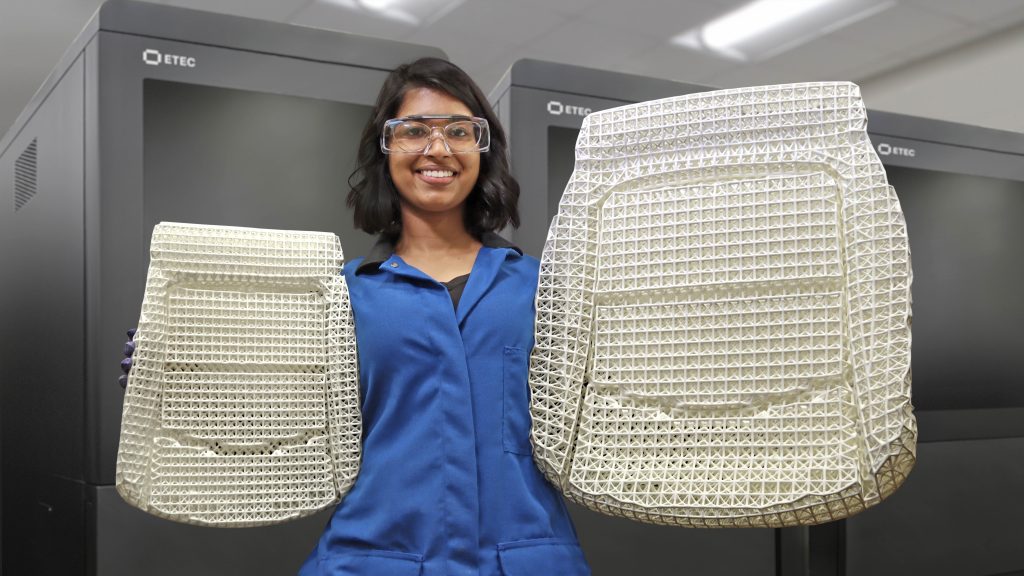
3D printer manufacturer Desktop Metal has debuted FreeFoam, a new 3D printable photopolymer resin family that contains heat-activated foaming agents.
Invented by Texas-based materials specialist Adaptive3D, a Desktop Metal subsidiary acquired in 2021, FreeFoam can be programmed to expand anywhere between 2 to 7 times its original printed size without any tooling. The result is the production of tunable and durable closed cell foam parts, which are expected to see extensive use in sectors such as automotive, furniture, sporting goods, footwear, and healthcare.
Initially available exclusively on the ETEC Xtreme 8K DLP 3D printer, FreeFoam will be showcased at Foam Expo North America in Michigan from June 28-30. The Expo will feature a 3D printed FreeFoam car seat developed in partnership with Camaco.
“FreeFoam is one of the most exciting and commercially significant photopolymer solutions to come to market in the industrial printing space in years,” said Ric Fulop, founder and CEO of Desktop Metal. “The market for conventionally manufactured foam has many challenges – from expensive molds that limit designs to dense and heavy foams that absorb water and are expensive to ship and drive, to the inability to easily dial in strength and Shore hardness values in specific foam designs.”
“In the quantum multiverse, every choice, every decision you've ever and never made exists in an unimaginably vast ensemble of parallel universes.”
-
weatheriscool
- Posts: 25737
- Joined: Sun May 16, 2021 6:16 pm
- Contact:
Re: 3D Printing News & Discussions
New 3D printing process is faster and more precise than conventional methods
https://techxplore.com/news/2022-08-3d- ... thods.html
by Greg Bruno, Rutgers University
https://techxplore.com/news/2022-08-3d- ... thods.html
by Greg Bruno, Rutgers University
Rutgers engineers have created a way to 3D print large and complex parts at a fraction of the cost of current methods.
They detail their work in the journal Additive Manufacturing.
"We have more tests to run to understand the strength and geometric potential of the parts we can make, but as long as those elements are there, we believe this could be a game changer for the industry," said Jeremy Cleeman, a graduate student researcher at the Rutgers School of Engineering and the lead author of the study.
The new approach, called Multiplexed Fused Filament Fabrication (MF3), uses a single gantry, the sliding structure on a 3D printer, to print individual or multiple parts simultaneously. By programming their prototype to move in efficient patterns, and by using a series of small nozzles—rather than a single large nozzle, as is common in conventional printing—to deposit molten material, the researchers were able to increase printing resolution and size as well as significantly decrease printing time.
"MF3 will change how thermo-plastic printing is done," said Cleeman, noting his team has applied for a U.S. patent for their technology.
The 3D-printing industry has struggled with what is known as the throughput-resolution tradeoff—the speed at which 3D printers deposit material versus the resolution of the finished product. Larger-diameter nozzles are faster than smaller ones but generate more ridges and contours that must be smoothed out later, adding significant post-production costs.
By contrast, smaller nozzles deposit material with greater resolution, but current methods with conventional software are too slow to be cost effective.
At the heart of MF3's innovation is its software. To program a 3D printer, engineers use a software tool called a slicer—computer code that maps an object into the virtual "slices," or layers, that will be printed. Rutgers researchers wrote slicer software that optimized the gantry arm's movement and determined when the nozzles should be turned on and off to achieve the highest efficiency. MF3's new "toolpath strategy" makes it possible to "concurrently print multiple, geometrically distinct, non-contiguous parts of varying sizes" using a single printer, the researchers wrote in their study.
Re: 3D Printing News & Discussions
New Granular Hydrogel Bioink Could Expand Possibilities for Tissue Bioprinting
September 1, 2022
Introduction:
Read more of the EurekAlert article here: https://www.eurekalert.org/news-releases/963547
For a technical presentation of the approach as published in the journal Small: https://onlinelibrary.wiley.com/doi/ep ... 202202390
September 1, 2022
Introduction:
(EurekAlert) Every day in the United States, 17 people die waiting for an organ transplant, and every nine minutes, another person is added to the transplant waiting list, according to the Health Resources and Services Administration. One potential solution to alleviate the shortage is to develop biomaterials that can be three-dimensionally (3D) printed as complex organ shapes, capable of hosting cells and forming tissues. Attempts so far, though, have fallen short, with the so-called bulk hydrogel bioinks failing to integrate into the body properly and support cells in thick tissue constructs.
Now, Penn State researchers have developed a novel nanoengineered granular hydrogel bioink that makes use of self-assembling nanoparticles and hydrogel microparticles, or microgels, to achieve previously unattained levels of porosity, shape fidelity and cell integration.
The team published their approach in the journal Small.
Read more of the EurekAlert article here: https://www.eurekalert.org/news-releases/963547
For a technical presentation of the approach as published in the journal Small: https://onlinelibrary.wiley.com/doi/ep ... 202202390
Don't mourn, organize.
-Joe Hill
-Joe Hill
-
weatheriscool
- Posts: 25737
- Joined: Sun May 16, 2021 6:16 pm
- Contact:
Re: 3D Printing News & Discussions
New 3D printing process offers novel energy storage design options
https://phys.org/news/2022-09-3d-energy ... tions.html
by Neil Martin, University of New South Wales
https://phys.org/news/2022-09-3d-energy ... tions.html
by Neil Martin, University of New South Wales
UNSW engineers have developed a process to print solid-state polymer electrolytes into any shape desired for use in energy storage.
The research team from the School of Chemical Engineering led by Professor Cyrille Boyer, including Dr. Nathaniel Corrigan and Kenny Lee—say the 3D printing process of such material could be particularly useful in future medical devices where small, intricately designed energy storage offers a number of benefits.
Solid-state electrolytes are a key component in solid-state batteries, although traditionally they have suffered from poor performance due to low ionic conductivities or poor mechanical properties.