Climate Change News & Discussions
-
weatheriscool
- Posts: 25740
- Joined: Sun May 16, 2021 6:16 pm
- Contact:
-
weatheriscool
- Posts: 25740
- Joined: Sun May 16, 2021 6:16 pm
- Contact:
-
weatheriscool
- Posts: 25740
- Joined: Sun May 16, 2021 6:16 pm
- Contact:

Re: Climate Change News & Discussions
Paper Argues Reducing Greenhouse Gas Emissions is Not Enough to Combat Climate Change
November 2, 2023
Introduction:
November 2, 2023
Introduction:
Read more here: https://www.eurekalert.org/news-releases/1006073(Eurekalert) According to a new paper in Oxford Open Climate Change, published by Oxford University Press, the strategies humanity must pursue to reduce climate change will have to include more than reducing greenhouse gases. This comes from an analysis of climate data led by researcher James Hansen.
Scientists have known since the 1800s that infrared-absorbing (greenhouse) gases warm the Earth’s surface and that the abundance of greenhouse gases changes naturally as well as from human actions. Roger Revelle, who was one of the early scientists to study global warming, wrote in 1965 that industrialization meant that human beings were conducting a “vast geophysical experiment” by burning fossil fuels, which adds carbon dioxide (CO2) to the air. CO2 has now reached levels that have not existed for millions of years.
Climate sensitivity
A long-standing issue concerns how much global temperature will rise for a specified CO2 increase. A 1979 study released by the United States National Academy of Sciences concluded that doubling atmospheric CO2 with ice sheets fixed would likely cause global warming between 1.5 and 4.5° Celsius. This was a large range, and there was additional uncertainty about the delay in warming caused by Earth’s massive ocean. This new paper reevaluates climate sensitivity based on improved paleoclimate data, finding that climate is more sensitive than usually assumed. Their best estimate for doubled CO2 is global warming of 4.8°C, significantly larger than the 3°C best estimate of the United Nations Intergovernmental Panel on Climate Change.
Aerosols
The authors also conclude that much of the expected greenhouse gas warming in the past century has been offset by the cooling effect of human-made aerosols – fine airborne particles. Aerosols have declined in amount since 2010 as a result of reduced air pollution in China and global restrictions on aerosol emissions from ships. This aerosol reduction is good for human health, as particulate air pollution kills several million people per year and adversely affects the health of many more people. However, aerosol reduction is now beginning to unmask greenhouse gas warming that had been hidden by aerosol cooling. The authors have long termed the aerosol cooling a “Faustian bargain” because, as humanity eventually reduces air pollution, payment in the form of increased warming comes due.
Don't mourn, organize.
-Joe Hill
-Joe Hill

-
weatheriscool
- Posts: 25740
- Joined: Sun May 16, 2021 6:16 pm
- Contact:
Re: Climate Change News & Discussions
CPC Weekly update of 11/6/23 has Niño 3.4 up to +1.8C.
The latest weekly
SST departures are:
Niño 4=+1.4ºC
Niño 3.4= +1.8ºC
Niño 3= +2.1ºC
Niño 1+2= +2.2ºC
https://www.cpc.ncep.noaa.gov/products/ ... ts-web.pdf
The latest weekly
SST departures are:
Niño 4=+1.4ºC
Niño 3.4= +1.8ºC
Niño 3= +2.1ºC
Niño 1+2= +2.2ºC
https://www.cpc.ncep.noaa.gov/products/ ... ts-web.pdf
-
weatheriscool
- Posts: 25740
- Joined: Sun May 16, 2021 6:16 pm
- Contact:
Re: Climate Change News & Discussions
Capturing Carbon with Seaweed: What We Know, What We Don’t, and What We’re Totally Unsure About
by Clare Wilson
November 1, 2023
Introduction:
1,100 words, about 5 minutes. Listed length does not included related studies for which links are provided.
by Clare Wilson
November 1, 2023
Introduction:
Read more here (including links to related studies): https://hakaimagazine.com/news/capturi ... re-about/(Hakai Magazine) In the world of carbon offset trading, kelp is a big buzzword. Golden-brown and glistening, certain seaweeds are catching the attention of investors for their seeming propensity to grab vast amounts of carbon and pack it away for the long haul. With companies already clamoring for consumers’ climate-conscious dollars, many scientists worry enthusiasm for the burgeoning industry is getting ahead of what kelp can actually deliver.
The reality is, scientists don’t know nearly enough about seaweed’s capacity to pull carbon out of the atmosphere and store it long term, a process known as carbon sequestration. And some of the outstanding questions are pretty big: How much carbon does seaweed pull out of seawater? When it dies, how much carbon sinks to the seafloor and stays there? How much ends up back in the food chain? And, of the carbon that sinks, how long does it stay locked away? So far, only rough estimates are available. But answering these questions with greater certainty could either water down seaweed’s carbon sequestration potential or cement it.
Fortunately, researchers are working to fill in these gaps. In the past few years, scientists have published a slew of review papers, weighing the evidence and probing what we know, what we don’t know, and what we really don’t know about how seaweeds store carbon.
1,100 words, about 5 minutes. Listed length does not included related studies for which links are provided.
Don't mourn, organize.
-Joe Hill
-Joe Hill
Re: Climate Change News & Discussions
We're Disrupting Another Major Earth Cycle, and No One's Talking About It
by David Nield
November 5, 2023
Introduction:
by David Nield
November 5, 2023
Introduction:
Read more here: https://www.sciencealert.com/were-disr ... about-it(Science Alert) Human activity is heating up the planet, putting wildlife in danger, and even altering Earth's spin. Now it appears we're also having a seriously detrimental effect on the planet's natural salt cycle, a new study reveals.
While geological and hydrological processes naturally bring salt up to Earth's surface over long time spans, we're speeding up this natural flow due to mining, land development, and the use of road salts to melt ice.
Researchers from the University of Maryland, the University of Connecticut, Virginia Tech and other institutions have all combined their expertise to document what they describe as an "existential threat" to supplies of freshwater.
The team looked at a variety of different salts – not just the sodium chloride variety most of us readily use in our cooking – and in a range of different environments, including salt concentrations in rivers and in soils. Certain events, like lakes drying up, are even adding to salt concentrations in the air.
Don't mourn, organize.
-Joe Hill
-Joe Hill
Re: Climate Change News & Discussions
Climate change: Intensity of ongoing drought in Syria, Iraq and Iran ‘not rare anymore’
8 November 2023
High temperatures caused by climate change are driving an ongoing drought in the Middle East, according to a new rapid attribution analysis by the World Weather Attribution service.
Large parts of Iraq, Iran and Syria have been gripped by an intense drought for years. Low rainfall and high temperatures have caused crops to fail and driven water shortages across the region, pushing millions of people into food insecurity.
The study finds that, between July 2020 and June 2023, climate change made the drought more intense – mainly due to high temperatures that dried out the soil.
In a world without climate change, the dry period would not have even been severe enough to be called a drought, the study notes.
[...]
In today’s climate, the drought in Iran was a one-in-five year event. However, without the influence of climate change, it would have been a one-in-80 year event.
https://www.carbonbrief.org/climate-cha ... e-anymore/

SPEI in the Tigris-Euphrates river basin (left) and Iran (right) between July 2020 and June 2023. Source: WWA (2023)
8 November 2023
High temperatures caused by climate change are driving an ongoing drought in the Middle East, according to a new rapid attribution analysis by the World Weather Attribution service.
Large parts of Iraq, Iran and Syria have been gripped by an intense drought for years. Low rainfall and high temperatures have caused crops to fail and driven water shortages across the region, pushing millions of people into food insecurity.
The study finds that, between July 2020 and June 2023, climate change made the drought more intense – mainly due to high temperatures that dried out the soil.
In a world without climate change, the dry period would not have even been severe enough to be called a drought, the study notes.
[...]
In today’s climate, the drought in Iran was a one-in-five year event. However, without the influence of climate change, it would have been a one-in-80 year event.
https://www.carbonbrief.org/climate-cha ... e-anymore/
SPEI in the Tigris-Euphrates river basin (left) and Iran (right) between July 2020 and June 2023. Source: WWA (2023)
-
weatheriscool
- Posts: 25740
- Joined: Sun May 16, 2021 6:16 pm
- Contact:
-
weatheriscool
- Posts: 25740
- Joined: Sun May 16, 2021 6:16 pm
- Contact:
Re: Climate Change News & Discussions
Worsening warming is hurting people in all regions, US climate assessment shows
Source: AP
Updated 5:05 AM EST, November 14, 2023
Source: AP
Updated 5:05 AM EST, November 14, 2023
Read more: https://apnews.com/article/climate-chan ... 111028aa0c
Revved-up climate change now permeates Americans’ daily lives with harm that is “already far-reaching and worsening across every region of the United States,” a massive new government report says.
The National Climate Assessment, which comes out every four to five years, was released Tuesday with details that bring climate change’s impacts down to a local level.
Overall, it paints a picture of a country warming about 60% faster than the world as a whole, one that regularly gets smacked with costly weather disasters and faces even bigger problems in the future.
Since 1970, the Lower 48 states have warmed by 2.5 degrees (1.4 degrees Celsius) and Alaska has heated up by 4.2 degrees (2.3 degrees Celsius), compared to the global average of 1.7 degrees (0.9 degrees Celsius), the report said. But what people really feel is not the averages, but when weather is extreme.
Re: Climate Change News & Discussions
The Zero Emissions Commitment and climate stabilization
14 Nov 2023
Abstract
How do we halt global warming? Reaching net zero carbon dioxide (CO2) emissions is understood to be a key milestone on the path to a safer planet. But how confident are we that when we stop carbon emissions, we also stop global warming? The Zero Emissions Commitment (ZEC) quantifies how much warming or cooling we can expect following a complete cessation of anthropogenic CO2 emissions. To date, the best estimate by the Intergovernmental Panel on Climate Change (IPCC) Sixth Assessment Report is zero change, though with substantial uncertainty. In this article, we present an overview of the changes expected in major Earth system processes after net zero and their potential impact on global surface temperature, providing an outlook toward building a more confident assessment of ZEC in the decades to come. We propose a structure to guide research into ZEC and associated changes in the climate, separating the impacts expected over decades, centuries, and millennia. As we look ahead at the century billed to mark the end of net anthropogenic CO2 emissions, we ask: what is the prospect of a stable climate in a post-net zero world?
https://www.frontiersin.org/journals/sc ... 70744/full
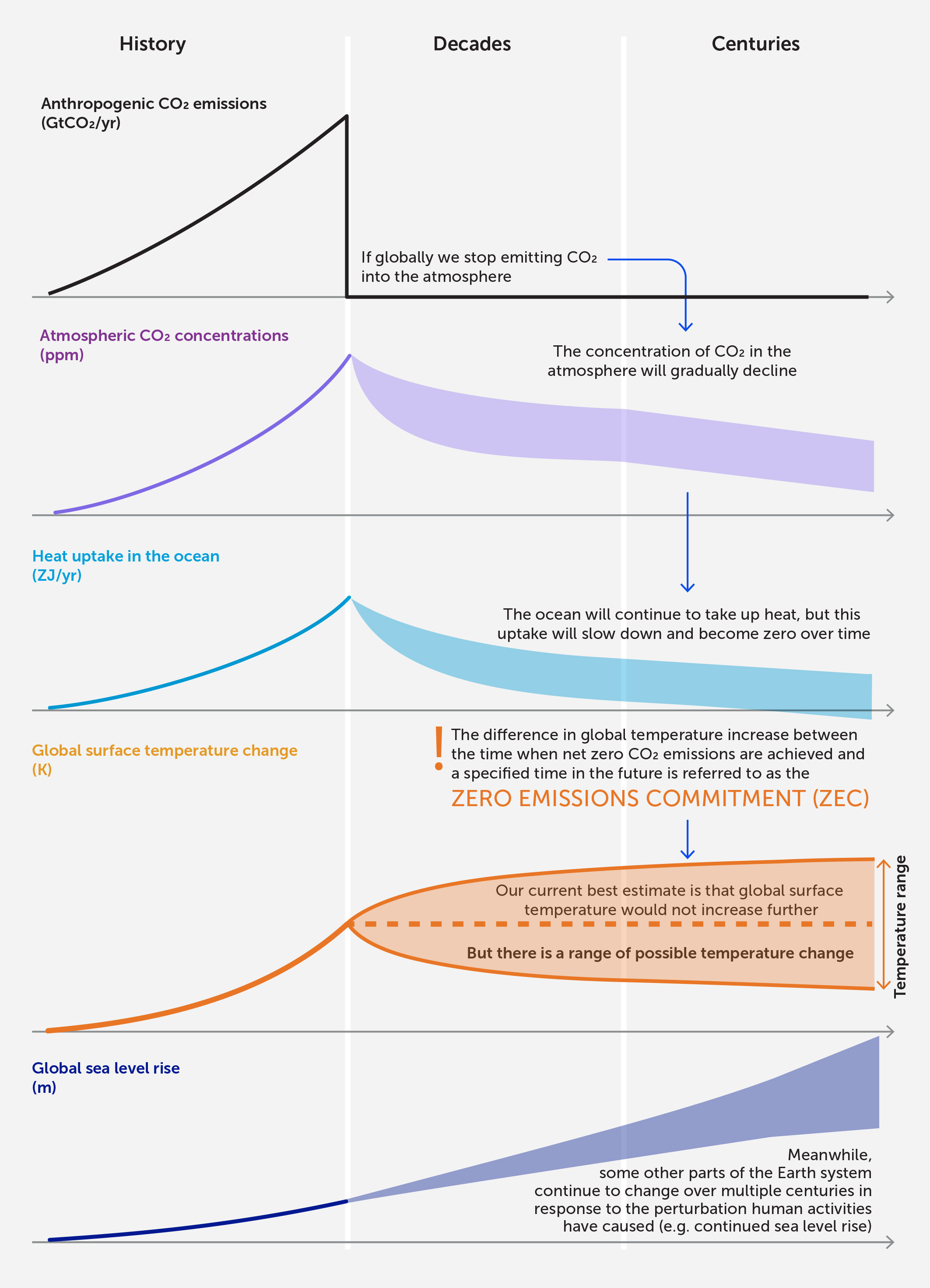
14 Nov 2023
Abstract
How do we halt global warming? Reaching net zero carbon dioxide (CO2) emissions is understood to be a key milestone on the path to a safer planet. But how confident are we that when we stop carbon emissions, we also stop global warming? The Zero Emissions Commitment (ZEC) quantifies how much warming or cooling we can expect following a complete cessation of anthropogenic CO2 emissions. To date, the best estimate by the Intergovernmental Panel on Climate Change (IPCC) Sixth Assessment Report is zero change, though with substantial uncertainty. In this article, we present an overview of the changes expected in major Earth system processes after net zero and their potential impact on global surface temperature, providing an outlook toward building a more confident assessment of ZEC in the decades to come. We propose a structure to guide research into ZEC and associated changes in the climate, separating the impacts expected over decades, centuries, and millennia. As we look ahead at the century billed to mark the end of net anthropogenic CO2 emissions, we ask: what is the prospect of a stable climate in a post-net zero world?
https://www.frontiersin.org/journals/sc ... 70744/full
-
weatheriscool
- Posts: 25740
- Joined: Sun May 16, 2021 6:16 pm
- Contact:
Re: Climate Change News & Discussions
The planet just had its warmest October on record
So far, 2023 is a record-warm year for the globe
https://www.noaa.gov/news/planet-just-h ... -on-record
November 15, 2023
So far, 2023 is a record-warm year for the globe
https://www.noaa.gov/news/planet-just-h ... -on-record
November 15, 2023
The planet added another record-breaking month to 2023, with October ranking as the warmest October in the 174-year global climate record.
Last month was also 2023’s fifth month in a row of record-warm global temperatures, according to scientists from NOAA’s National Centers for Environmental Information.
Below are more highlights from NOAA’s October global climate report:
Climate by the numbers
October 2023
The average global temperature for October was 2.41 degrees F (1.34 degrees C) above the 20th-century average of 57.1 degrees F (14.0 degrees C), ranking as the world’s warmest October on record. This was 0.43 of a degree F (0.24 of a degree C) above the previous record from October 2015. For the seventh-consecutive month, global ocean surface temperature also set a record high.
Looking regionally, Asia and South America had their warmest Octobers on record, while Africa, Europe and North America each had their second-warmest Octobers.
Last month was the 47th-consecutive October and the 536th-consecutive month with global temperatures above the 20th-century average. The past 10 Octobers (2014–2023) have all been the warmest Octobers in NOAA’s global climate record.
The year to date (YTD, January through October 2023)
The YTD average global surface temperature ranked as the warmest such period on record at 2.03 degrees F (1.13 degrees C) above the 20th-century average.
According to NCEI’s Global Annual Temperature Outlook, there is a greater than 99% chance that 2023 will rank as the warmest year on record for the world.
-
weatheriscool
- Posts: 25740
- Joined: Sun May 16, 2021 6:16 pm
- Contact:
-
firestar464
- Posts: 8321
- Joined: Wed Oct 12, 2022 7:45 am
Re: Climate Change News & Discussions
New research suggests plants might be able to absorb more CO2 from human activities than previously expected
https://phys.org/news/2023-11-absorb-co ... ously.html
https://phys.org/news/2023-11-absorb-co ... ously.html
-
weatheriscool
- Posts: 25740
- Joined: Sun May 16, 2021 6:16 pm
- Contact:
Re: Climate Change News & Discussions
The October global surface temperature was 1.34°C (2.41°F) above the 20th-century average of 14.0°C (57.1°F), making it the warmest October on record. This was 0.24°C (0.43°F) above the previous record from October 2015. October 2023 marked the 47th-consecutive October and the 536th-consecutive month with temperatures at least nominally above the 20th-century average. The past 10 Octobers (2014–2023) have been the warmest Octobers on record.
Year-to-date Temperature: January–October 2023
The January–October global surface temperature ranked highest in the 174-year record at 1.13°C (2.03°F) above the 1901–2000 average of 14.1°C (57.4°F). This surpassed the previous record from January–October 2016 by 0.08°C (0.14°F). According to NCEI's statistical analysis and data through October, there is a greater than 99% chance that 2023 will rank as the warmest year on record.
https://www.ncei.noaa.gov/access/monito ... bal/202310
Year-to-date Temperature: January–October 2023
The January–October global surface temperature ranked highest in the 174-year record at 1.13°C (2.03°F) above the 1901–2000 average of 14.1°C (57.4°F). This surpassed the previous record from January–October 2016 by 0.08°C (0.14°F). According to NCEI's statistical analysis and data through October, there is a greater than 99% chance that 2023 will rank as the warmest year on record.
https://www.ncei.noaa.gov/access/monito ... bal/202310
-
weatheriscool
- Posts: 25740
- Joined: Sun May 16, 2021 6:16 pm
- Contact:
-
weatheriscool
- Posts: 25740
- Joined: Sun May 16, 2021 6:16 pm
- Contact:
Re: Climate Change News & Discussions
Let Forests Grow Old to Store Huge Volume of Carbon
by Patrick Greenfield
November 13, 2023
Introduction:
The article also cites an earlier article concerning Republican proposals to plant a trillion trees and debunking overly optimistic claims as to the potential positive effect of such an action:
https://www.theguardian.com/environment ... -next-aoe
by Patrick Greenfield
November 13, 2023
Introduction:
Read more here: https://www.theguardian.com/environmen ... y-trees(The Guardian) Forest conservation and restoration could make a major contribution to tackling the climate crisis as long as greenhouse gas emissions are slashed, according to a study.
By allowing existing trees to grow old in healthy ecosystems and restoring degraded areas, scientists say 226 gigatonnes of carbon could be sequestered, equivalent to nearly 50 years of US emissions for 2022. But they caution that mass monoculture tree-planting and offsetting will not help forests realise their potential.
Humans have cleared about half of Earth’s forests and continue to destroy places such as the Amazon rainforest and the Congo basin that play crucial roles in regulating the planet’s atmosphere.
The research, published on Monday in the journal Nature as part of a collaboration between hundreds of leading forest ecologists, estimates that outside of urban agricultural areas in regions with low human footprints where forests naturally exist, they could draw down large amounts of carbon.
About 61% of the potential could be realised by protecting standing forests, allowing them to mature into old growth ecosystems like Białowieża forest in Poland and Belarus or California’s sequoia groves, which survived for thousands of years. The remaining 39% could be achieved by restoring fragmented forests and areas that have already been cleared.
The article also cites an earlier article concerning Republican proposals to plant a trillion trees and debunking overly optimistic claims as to the potential positive effect of such an action:
https://www.theguardian.com/environment ... -next-aoe
Don't mourn, organize.
-Joe Hill
-Joe Hill