BCIs & Neurotechnology News and Discussions

weatheriscool
Posts: 24486
Joined: Sun May 16, 2021 6:16 pm
Contact:

Re: BCIs & Neurotechnology News and Discussions

Post by weatheriscool »

weatheriscool
Posts: 24486
Joined: Sun May 16, 2021 6:16 pm
Contact:

Re: BCIs & Neurotechnology News and Discussions

Post by weatheriscool »

First 'smart,' wearable, pediatric soft exoskeleton provides mobility for children with motor difficulties
https://medicalxpress.com/news/2025-04- ... leton.html
by Laurie Fickman, University of Houston
Just one look at the next-generation lightweight, soft exoskeleton for children with cerebral palsy reveals the powerful role technology can play in solving global challenges and improving lives.

Built to help children walk, MyoStep addresses motor impairments that severely restrict children's participation in physical activities, self-care and academic pursuits, leading to developmental delays, social isolation and reduced self-esteem. It is lightweight, discreet, made of smart materials and wearable technology, and tailored to fit seamlessly into the lives of children and their families.

The MyoStep soft exoskeleton is introduced in IEEE Electron Devices Magazine by a team from the NSF UH Building Reliable Advances and Innovation in Neurotechnology (BRAIN) Center, an Industry–University Cooperative Research Center (IUCRC) and TIRR Memorial Hermann.

"The MyoStep project represents a significant advancement in the field of pediatric mobility aids, particularly for children with cerebral palsy," said Jose Luis Contreras-Vidal, director of the NSF BRAIN Center, and Hugh Roy and Lillie Cranz Cullen Distinguished Professor of Electrical and Computer Engineering.
weatheriscool
Posts: 24486
Joined: Sun May 16, 2021 6:16 pm
Contact:

Re: BCIs & Neurotechnology News and Discussions

Post by weatheriscool »

Neuralink's speech restoration device gets FDA's 'breakthrough' tag

Source: Reuters

Neuralink has received the U.S. Food and Drug Administration's "breakthrough" tag for its device to restore communication for individuals with severe speech impairment, Elon Musk's brain implant company said on Thursday in a post on X.

The device would help those affected by amyotrophic lateral sclerosis (ALS), stroke, spinal cord injury, cerebral palsy, multiple sclerosis, and other neurological conditions, the company said.

The health regulator's breakthrough devices program is intended to provide patients and health care providers with timely access to medical devices by speeding up development, assessment, and review, according to its website.

-snip-

Read more: https://www.reuters.com/business/health ... 025-05-01/
weatheriscool
Posts: 24486
Joined: Sun May 16, 2021 6:16 pm
Contact:

Re: BCIs & Neurotechnology News and Discussions

Post by weatheriscool »

You could soon control an iPhone with your thoughts, using Apple's new accessibility option
By Abhimanyu Ghoshal
May 14, 2025
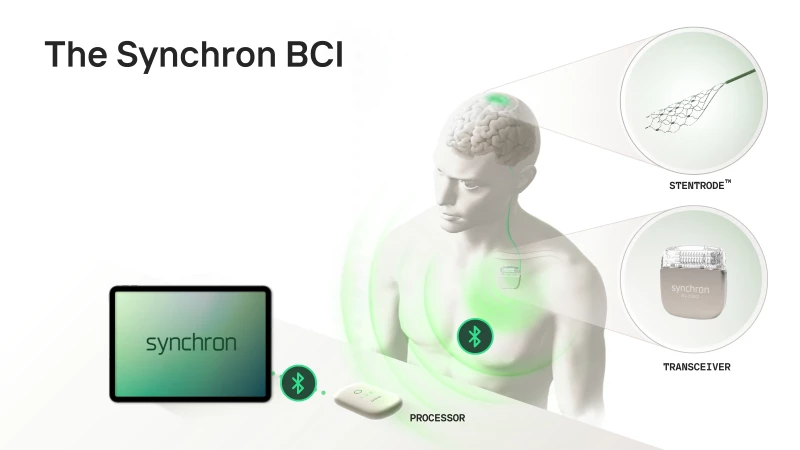
Apple is getting into the brain-computer interface (BCI) business, reveals a press release from New York-based startup Synchron. The idea is to enable people with limited mobility to use iPhones, iPads, and the Vision Pro headset by transmitting commands through their minds.
Image
Synchron, which was founded in 2016 by neurologist Dr. Tom Oxley, is a biomedicine outfit that's exploring an endovascular approach to connecting devices to the human brain. The startup, which is backed by Bill Gates and Jeff Bezos, uses a proprietary piece of hardware to detect brain signals without requiring open brain surgery to install – as is the case with Elon Musk-fronted Neuralink's tech.
https://newatlas.com/technology/apple-b ... -synchron/
User avatar
caltrek
Posts: 9280
Joined: Mon May 17, 2021 1:17 pm

Re: BCIs & Neurotechnology News and Discussions

Post by caltrek »

New Auditory Brainstem Implant Shows Early Promise
May 16, 2025

Introduction:
(Eurekalert) A new study co-led by Mass General Brigham researchers points to a promising new type of auditory brainstem implant (ABI) that could benefit people who are deaf due to Neurofibromatosis type 2 (NF2) and other severe inner ear abnormalities that prevent them from receiving cochlear implants. With further tests and trials, researchers hope it will provide a more effective treatment alternative than what is currently used.

In the new research, published in Nature Biomedical Engineering, scientists at Mass Eye and Ear, a member of the Mass General Brigham healthcare system, collaborated with scientists at the École Polytechnique Fédérale de Lausanne (EPFL) in Geneva, Switzerland, to report on a new class of soft, flexible ABIs that were designed to address the limitations of those currently used. These implants bypass damaged auditory structures and directly stimulate the brainstem’s sound-processing region to restore auditory function.

The new ABI was borne out of a decade-long collaboration between Mass Eye and Ear and EPFL scientists. It features an elastic, multilayer construct that includes ultra-thin platinum electrodes and silicone, a novel design that allows it to conform closely to the brainstem’s curved surface.

Conventional ABIs that are sometimes used in patients with NF2 rely on stiff electrodes that struggle to conform to the curved surface of the cochlear nucleus in the brainstem. That limits their effectiveness to modest benefits, typically providing only basic sound awareness to aid lip reading. The design can also cause side effects like discomfort that discourages long-term use.

The novel, soft electrode design was developed using advanced thin-film processing techniques, allowing for closer contact and more precise stimulation. In preclinical tests conducted in Switzerland, two macaques received the implants and underwent several months of behavioral testing. Results showed the animals could consistently distinguish between different patterns of stimulation — which indicated high-resolution auditory perception, a promising sign for eventual human use.

Read more of the Eurekalert article here: https://www.eurekalert.org/news-releases/1084146

For a technical presentation of the results of the study as published in Nature https://www.nature.com/articles/s41551-025-01378-9
Don't mourn, organize.

-Joe Hill
User avatar
wjfox
Site Admin
Posts: 13575
Joined: Sat May 15, 2021 6:09 pm
Location: Essex, UK
Contact:

Re: BCIs & Neurotechnology News and Discussions

Post by wjfox »

Lilymoon
Posts: 186
Joined: Sun Apr 17, 2022 2:12 pm

Re: BCIs & Neurotechnology News and Discussions

Post by Lilymoon »

University of Michigan achieves first human brain recording with wireless implant
New brain-computer interface shows promise in restoring communication
As the brain-computer interface technology field transitions from experimental demonstrations to practical clinical applications, the University of Michigan has just achieved a milestone that could make high-performance, wireless BCIs a reality for people living with paralysis, speech loss, and other challenging conditions. The successful test of a fully implantable device in a human patient signals a new era in neurotechnology, where restoring lost functions through brain-to-computer communication is moving closer to everyday clinical use.
In a significant advance for brain-computer interface (BCI) technology, a University of Michigan research team has achieved the first in-human recording using Paradromics' Connexus device – a wireless, fully implantable BCI designed to restore communication and movement for people living with severe neurological conditions. The procedure took place on May 14, 2025, during epilepsy surgery, where the device was temporarily placed on the patient's temporal lobe, an area essential for processing sound and memory. This opportunity allowed the team to safely test the device's ability to capture neural signals without adding risk to the patient, as the surgery already required access to the brain.
The Connexus stands out for its compact size – smaller than a dime – and its high-density array of 421 microelectrodes, each thinner than a human hair. Unlike many earlier BCIs, which often relied on fewer electrodes and required external wires, Connexus is engineered to be fully implantable. The device collects electrical signals from individual neurons, transmitting them via a thin lead to a transceiver implanted in the chest. From there, the data is sent wirelessly to an external computer, where artificial intelligence algorithms interpret the patterns and translate them into actions, such as moving a cursor or generating synthesized speech.
read more here.

https://www.techspot.com/news/108160-un ... eless.html
weatheriscool
Posts: 24486
Joined: Sun May 16, 2021 6:16 pm
Contact:

Re: BCIs & Neurotechnology News and Discussions

Post by weatheriscool »

First-of-its-kind technology helps man with ALS speak in real time
https://medicalxpress.com/news/2025-06- ... -real.html
by UC Davis

Researchers at the University of California, Davis, have developed an investigational brain-computer interface that holds promise for restoring the voices of people who have lost the ability to speak due to neurological conditions.

In a new study published in the journal Nature, the researchers demonstrate how this new technology can instantaneously translate brain activity into voice as a person tries to speak—effectively creating a digital vocal tract.

The system allowed the study participant, who has amyotrophic lateral sclerosis (ALS), to speak through a computer with his family in real time, change his intonation and sing simple melodies.Image
"Translating neural activity into text, which is how our previous speech brain-computer interface works, is akin to text messaging. It's a big improvement compared to standard assistive technologies, but it still leads to delayed conversation. By comparison, this new real-time voice synthesis is more like a voice call," said Sergey Stavisky, senior author of the paper and an assistant professor in the UC Davis Department of Neurological Surgery. Stavisky co-directs the UC Davis Neuroprosthetics Lab.
weatheriscool
Posts: 24486
Joined: Sun May 16, 2021 6:16 pm
Contact:

Re: BCIs & Neurotechnology News and Discussions

Post by weatheriscool »

Brain implant breakthrough helps ALS man talk – and sing – again
By Abhimanyu Ghoshal
June 14, 2025
In another advancement in the field of brain-computer interfaces (BCI), a new implant-based system has enabled a paralyzed person to not only talk, but also 'sing' simple melodies through a computer – with practically no delay.

The tech developed by researchers at University of California, Davis (UC Davis) was trialed with a study participant who suffers from amyotrophic lateral sclerosis (ALS). It essentially captured raw neural signals through four microelectrode arrays surgically implanted into the region of the brain responsible for physically producing speech. In combination with low-latency processing and an AI-driven decoding model, the participant's speech was synthesized in real time through a speaker.

To be clear, this means the system isn't trying to read the participant's thoughts, bur rather translating the brain signals produced when he tries to use his muscles to speak.
https://newatlas.com/medical-tech/brain ... talk-sing/
weatheriscool
Posts: 24486
Joined: Sun May 16, 2021 6:16 pm
Contact:

Re: BCIs & Neurotechnology News and Discussions

Post by weatheriscool »

weatheriscool
Posts: 24486
Joined: Sun May 16, 2021 6:16 pm
Contact:

Re: BCIs & Neurotechnology News and Discussions

Post by weatheriscool »

weatheriscool
Posts: 24486
Joined: Sun May 16, 2021 6:16 pm
Contact:

Re: BCIs & Neurotechnology News and Discussions

Post by weatheriscool »

firestar464
Posts: 7202
Joined: Wed Oct 12, 2022 7:45 am

Re: BCIs & Neurotechnology News and Discussions

Post by firestar464 »

More on that by Benzinga:

https://www.benzinga.com/25/05/45538889 ... omic-forum

oh god please no
weatheriscool
Posts: 24486
Joined: Sun May 16, 2021 6:16 pm
Contact:

Re: BCIs & Neurotechnology News and Discussions

Post by weatheriscool »

New tech for imaging brain waves could advance disease research, AI
https://medicalxpress.com/news/2025-07- ... sease.html
by Stanford University
When electrical activity travels across the brain, it moves like ripples on a pond. The motion of these "brain waves," first observed in the 1920s, can now be seen more clearly than ever before thanks to instruments and techniques created by a Stanford-led team.

The technology, described in the journal Cell, involves two ultra-sensitive optical instruments that can detect signals of genetically engineered proteins, known as "voltage indicators," revealing neuronal brain wave activity in mice.

While limited to research animals, the advance has already shown its potential. Using these instruments, the researchers discovered three new types of brain waves moving in ways never previously observed.

"We're getting a very broad view of waves propagating across the brain," said Mark J. Schnitzer, senior author and professor of biology and applied physics in Stanford's School of Humanities and Sciences.

"We can look at multiple brain areas at once and see the brain waves sweeping across the cortex, the brain's outermost layer of nerve tissue, with cell-type specificity."
weatheriscool
Posts: 24486
Joined: Sun May 16, 2021 6:16 pm
Contact:

Re: BCIs & Neurotechnology News and Discussions

Post by weatheriscool »

firestar464
Posts: 7202
Joined: Wed Oct 12, 2022 7:45 am

Re: BCIs & Neurotechnology News and Discussions

Post by firestar464 »

source pls
User avatar
caltrek
Posts: 9280
Joined: Mon May 17, 2021 1:17 pm

Re: BCIs & Neurotechnology News and Discussions

Post by caltrek »

Unlocking the Brain’s Filing Cabinet
July 24, 2025

Introduction:
( Eurekalert) Researchers at USC have made a significant breakthrough in understanding how the human brain forms, stores and recalls visual memories. A new study, published in Advanced Science, harnesses human patient brain recordings and a powerful machine learning model to shed new light on the brain’s internal code that sorts memories of objects into categories — think of it like the brain’s filing cabinet of imagery.

The results demonstrated that the research team could essentially read subjects’ minds, by pinpointing the category of visual image being recalled, purely from the precise timing of the subject’s neural activity.

The work solves a fundamental neuroscience debate and offers exciting potential for future brain-computer interfaces, including memory prostheses to restore lost memory in patients with neurological disorders like dementia. The research was led by Dong Song, associate professor in the Department of Neurological Surgery and the Alfred E. Mann Department of Biomedical Engineering. and Charles Liu, the USC Neurorestoration Center director at Keck School of Medicine of USC and professor of biomedical engineering at USC Viterbi School of Engineering. The first author, Xiwei She, is a former Ph.D. student from the Song Lab and is currently a postdoctoral researcher at Stanford University.
Conclusion:
“While this result may be important to all patients who suffer memory disorders, it has profound relevance specifically to the epilepsy patients who participated in the studies, many of whom suffer from hippocampal dysfunction that manifests in both seizures as well as cognitive/memory disorders.”
Read more of the Eurekalert article here: https://www.eurekalert.org/news-releases/1092458

For a presentation of the results of the study as published in Advanced Science : https://advanced.onlinelibrary.wiley.co ... 202502047
Don't mourn, organize.

-Joe Hill
weatheriscool
Posts: 24486
Joined: Sun May 16, 2021 6:16 pm
Contact:

Re: BCIs & Neurotechnology News and Discussions

Post by weatheriscool »

Post Reply